
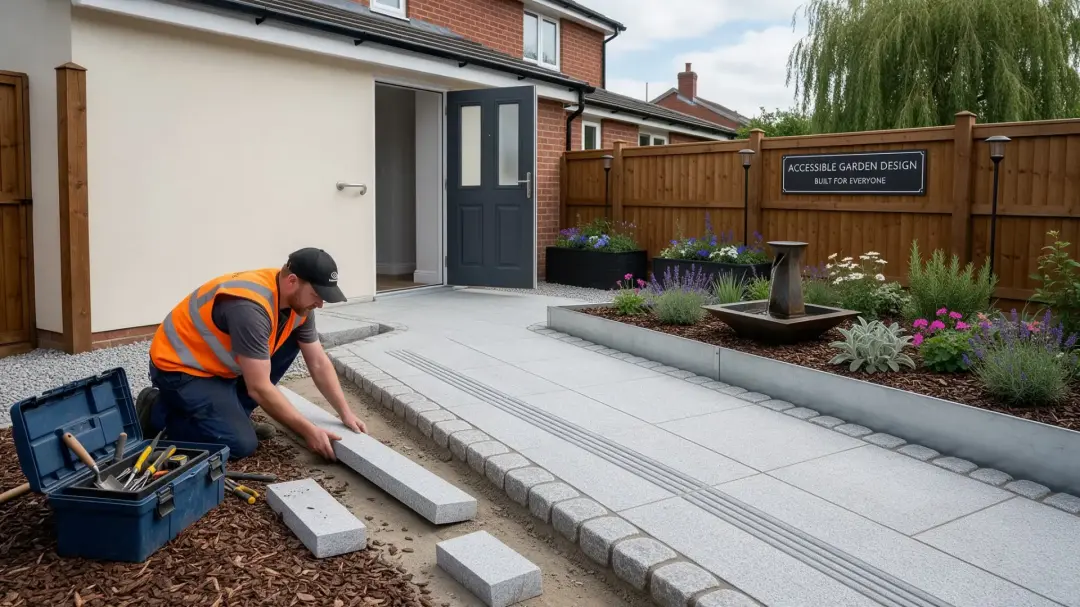
Practical Design Tips for Low-Maintenance Accessible Gardens
A low-maintenance accessible garden should save effort without losing character. This guide focuses on choices that make regular care simpler: easy-to-reach planting, durable paths, well-defined beds, sensible storage and planting schemes that do not demand constant cutting, watering or lifting.
Low-maintenance choices are also a practical response to changing weather. The Met Office projects that, by 2070 under a high-emissions scenario, UK summers could be up to 60% drier and hot summer days could be 4 to 7°C warmer. Drought-tolerant planting, mulching and straightforward irrigation access can help a garden remain manageable in dry spells. Read the Met Office UK climate projections.
Simplify the garden workload
Start with the jobs that currently take most effort. Mowing a large lawn, carrying water and bending to weed may each call for a different change, so ask the gardener which tasks they most want to reduce.
A smaller lawn or a planted border beside a firm path can free up time without making the garden feel bare. Keep the places used most often close to the house, with clear space between them. For example, replacing a narrow strip of grass that is hard to mow may remove more effort than changing a bed that already needs little attention.
Plan for the remaining upkeep too. Tools, garden waste and water should be reachable without repeated heavy lifting, and planted areas should be accessible from stable ground rather than from the middle of a soft bed.
Pick durable finishes
Paths and patios should feel dependable under feet, walking aids or wheels. Firm paving with sound joints is usually easier to cross and sweep than loose stones that shift each time someone moves over them.
Check how rainwater leaves the surface before settling on the final finish. Water pooling near a doorway or along the main route can make an otherwise useful area hard to enjoy after wet weather. If a surface sample is available, try it with the shoes or mobility equipment normally used in the garden, including at a turn rather than only in a straight line.
Look closely at edges and transitions during installation. A neat join between two surfaces reduces the chance of a foot or wheel catching and avoids a small defect becoming a recurring repair.
Choose manageable planting
Choose plants for the care the gardener wants to give, not simply for how much space is available. Well-spaced shrubs and perennials can offer colour and structure without a constant cycle of clipping and replanting.
Put favourite flowers and herbs where they can be reached from a secure path or a suitably positioned raised bed. Gardening then becomes part of an enjoyable routine instead of a reason to step onto uneven soil. Spacing also matters for future growth: allow enough room so paths do not disappear behind mature foliage and regular hard pruning does not become necessary.
Mulch bare ground to help limit weeds and retain moisture, while keeping stems clear. If irrigation would help, place its controls where the user can reach them and check how easily the system can be maintained.
Store equipment accessibly
A shed is only useful when its approach and doorway are easy to use. Leave a firm path and enough room to open the door fully, even when bins, pots or garden furniture are nearby.
Keep regularly used tools at a comfortable height near the entrance. A light hose, a stable shelf and somewhere to set a watering can can save many small lifts during a normal gardening session. A wide door and a clear floor inside storage are just as important as the path leading to it when a trolley or mobility aid is used.
Think through the whole task, including carrying compost or removing cuttings. Locating storage beside the work area can shorten those journeys, provided it does not narrow the main route through the garden.
Prepare for all seasons
A route that works in summer must also cope with fallen leaves and winter rain. Keep plants from spreading across paths, and choose surfaces that can be cleared and cleaned without specialist equipment.
Offer a comfortable place to sit in sun or shade, with an easy way back indoors when the weather changes. Lighting near the entrance and along a regular path can help on darker afternoons. Ask who will clear leaves or treat slippery patches and whether they can reach those places safely, especially when the usual gardener is away.
Revisit the layout during different seasons. Wet corners, exposed seating and hard-to-reach watering points may only become obvious later; small changes then can prevent the same chore or obstacle returning each year.
Explore Accessible Garden Landscaping
For more ideas about practical paths, patios, raised planting and access improvements, visit our wheelchair-friendly garden landscapers page for Cromer, Norwich and Norfolk.