
How to Design a Wheelchair-Friendly Garden
A wheelchair-friendly garden begins with the routes that make everyday outdoor life possible. This guide explains how to plan generous circulation space, choose practical surfaces, position seating and planting, and make turning, reaching and relaxing feel natural rather than restrictive.
Census 2021 recorded 10.4 million disabled people across England and Wales, an age-standardised 17.8% of the population. That scale is a reminder that inclusive garden design should be considered from the first sketch, rather than treated as an afterthought once a layout is built. Read the ONS Census 2021 disability data.
Map everyday routes first
Begin with the trips someone actually wants to make: from the door to a seat, a planter, a gate or a place to entertain. Draw those journeys before deciding where ornamental beds or lawn should sit.
Move through the existing garden together, noting thresholds, slopes, narrow points and doors that swing into the route. The user's own chair and preferred way of moving provide better evidence than a generic sketch. Include less obvious trips, such as reaching the bin or an outside tap, because a garden that supports leisure but blocks routine tasks still limits independence.
Connect useful areas with a continuous, firm route so each destination can be reached without reversing across soft ground. A loop may help in one garden; another may need a direct path and a comfortable turning point.
Allow comfortable turning space
A path may be wide enough for straight travel yet still fail at a sharp corner. Leave room near doors, seating, beds and gates, allowing for the chair's size and any person accompanying the user.
Check the space after accounting for open gates, table legs and planting that will spread. Furniture may fit on a plan but narrow the route once people are sitting around it. The turning area should stay clear when the garden is in use, not merely when it is empty; allow for people, open doors and seasonal pots.
Before paving is fixed, mark the proposed path and turning areas on the ground. Trying them with the actual chair where possible is more informative than relying on a measurement alone.
Choose reliable surfaces
Wheels travel best across a firm, stable finish with even joints. Loose stones, rocking slabs and raised edges interrupt movement, so preparation beneath the visible paving matters as much as the material selected.
Plan for water to leave the route without creating an awkward sideways slope. Check door thresholds, drain covers and joins between paths and patios, where a small height difference can become a daily obstacle. Where an older path meets new paving, inspect the joint after installation with the same care as the middle of the route, since that is where wheels can jolt.
Ask how the surface will be cleaned and repaired. A route that can be kept clear of leaves, moss and loose debris will remain more useful than one that only works when newly laid.
Bring planting within reach
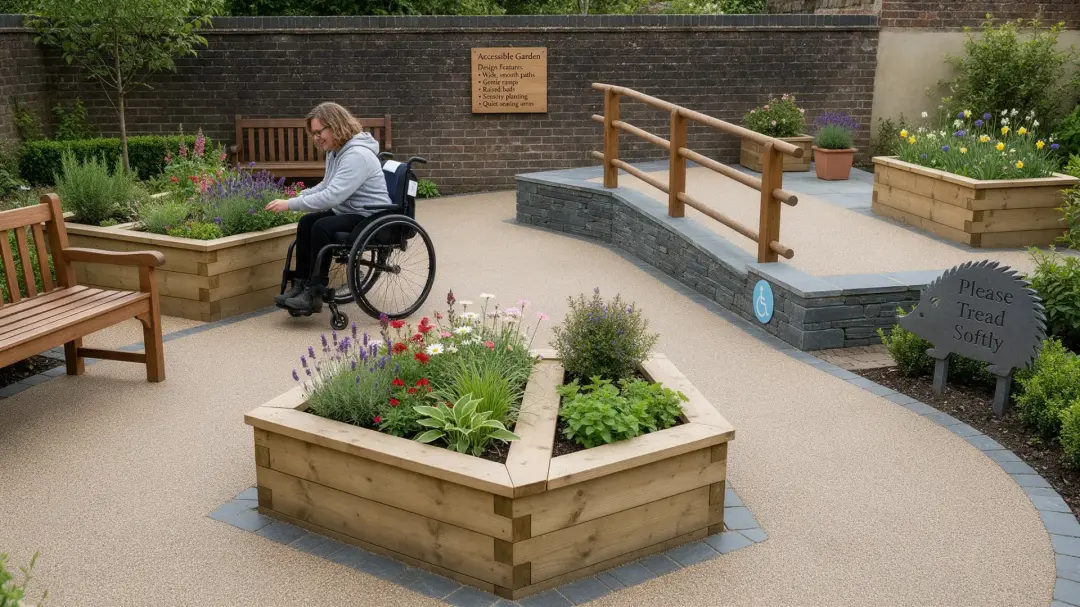
Position favourite plants beside a route that a wheelchair user can approach comfortably. A raised planter may help, but its height and depth should follow the gardener's reach rather than a standard display size.
Leave space for a chair to come alongside or for knees to fit beneath a work area where hands-on gardening is planned. Keep tools and water close enough to avoid repeated lifting. Try reaching into a proposed bed from the actual chair before choosing its final position; a drawing cannot show shoulder comfort or how far forward someone can lean.
Add scent, colour or texture where they can be enjoyed from a seated position. Keep thorny or spreading plants back from the travel route so the planting does not gradually reduce access.
Test the plan together
Show the layout to the person who will use the garden before work begins. Ask them to describe a normal visit outside, including opening the door, reaching a seat and returning indoors.
Use temporary markers for path edges, furniture and raised beds. Trying the route with the user's wheelchair can reveal a difficult turn or unreachable planter while the design is still easy to alter. If the user normally travels with another person, test that arrangement too, including whether there is room to pause together without blocking the path.
Review the completed route together as well. A change to furniture position, planting or lighting may make an otherwise good layout much more comfortable in everyday use.
Explore Accessible Garden Landscaping
For more ideas about practical paths, patios, raised planting and access improvements, visit our accessible garden design services page for Cromer, Norwich and Norfolk.